
Yoga Teacher Self-Care Check-In
Your Guide to Building a Sustainable Yoga Practice
Learn How to Maintain a Practice That Lasts
Self-care for yoga teachers is more than taking a day off, booking a massage, or rolling out your mat when you finally have extra time. For yoga teachers, self-care is part of what makes teaching sustainable.
Teaching yoga can be beautiful, meaningful, and deeply fulfilling. It can also require a lot of energy. As a yoga teacher, you are often holding space for other people, planning classes, preparing themes, cueing movement, watching bodies, reading the room, adjusting your language, supporting different levels of experience, and offering your presence again and again.
Even when you love the work, teaching yoga is still output.
That is why yoga teacher self-care matters.
A sustainable yoga practice is not only about how often you practice or how many classes you teach. It is about how you stay connected to yourself while continuing to serve others. It is about making sure your own practice still nourishes you, not just your students. It is about noticing the signs of yoga teacher burnout before they become your normal way of functioning.
If you are a yoga teacher, yoga teacher trainee, or someone considering yoga teacher training, this guide will help you think about self-care in a practical and sustainable way. We will look at how to keep your yoga practice alive, how to care for your energy, how to prevent burnout, and how to build rhythms that support both your teaching and your life.
Self-care for yoga teachers means creating practices, boundaries, and rhythms that support your body, mind, energy, and teaching life.
It does not have to be complicated. It does not have to be expensive. It does not have to look like anyone else’s routine.
For some yoga teachers, self-care means keeping a personal yoga practice that is not used for class planning. For others, it means resting after teaching, simplifying a schedule, setting boundaries around availability, staying connected to community, or continuing education in a way that feels supportive rather than overwhelming.
Self-care for yoga teachers can include:
A personal yoga practice
Rest after teaching
Boundaries around your schedule
Continuing education
Support from other teachers
Time away from content creation
Nervous system regulation
A sustainable teaching schedule
Hydration, food, sleep, and basic care
Space to receive, not just give
Self-care is not separate from teaching yoga. It is part of teaching yoga with integrity over time.
Yoga teachers spend a lot of time thinking about what students need.
What sequence will support them?
What theme will land?
What options should be offered?
What language will feel inclusive?
What pace will help them stay connected to breath?
What does this group need today?
Those are important questions. They are part of skillful teaching.
But yoga teachers also need to ask:
What do I need today?
How is my energy?
What support do I need before I teach?
What helps me feel steady?
What helps me transition after class?
The teacher needs care too. That care is not selfish. It is part of staying resourced enough to keep teaching with presence.
One of the biggest self-care lessons for yoga teachers is this: teaching yoga is not the same as being nourished by yoga.
Teaching can be meaningful. Teaching can feel energizing. Teaching can remind you why you love the practice. But teaching is still different from receiving the practice for yourself.
When you teach, part of your attention is outward. You are tracking time, sequence, students, transitions, safety, breath, music, props, energy, and language. You are holding the container.
That is very different from stepping onto your own mat and letting the practice hold you.
If you teach yoga, it is easy for every personal practice to become research.
You notice a transition and think, “I could teach this.”
You hear a phrase and think, “That would make a good theme.”
You practice a sequence and start imagining how it would work for students.
That is natural. Yoga teachers are always learning from practice.
But for sustainable yoga teaching, it helps to keep at least one practice that belongs only to you.
No filming.
No class planning.
No content.
No pressure to make it useful for anyone else.
Just your body, your breath, your attention, and your own relationship with yoga.
This kind of personal yoga practice can help you remember that you are still a student. It can also help prevent yoga teacher burnout because it gives you a place to receive rather than only offer.
Yoga teacher burnout can happen for many reasons. Sometimes it comes from teaching too many classes. Sometimes it comes from financial pressure, inconsistent income, emotional labor, unclear boundaries, constant marketing, or feeling like you have to be inspiring all the time.
Burnout can also happen when the thing that once nourished you becomes something you only give to others.
Yoga teachers may love the practice deeply and still become tired, resentful, scattered, or disconnected from their own mat.
Yoga teacher burnout can look like:
Feeling depleted after teaching
Dreading classes you used to enjoy
Losing connection to your own practice
Feeling resentful of students or studios
Overthinking every class theme or sequence
Feeling pressure to constantly create content
Teaching from autopilot
Saying yes when you need rest
Feeling like your teaching voice is flat or forced
Having no time to receive support yourself
Burnout does not mean you are a bad yoga teacher. It means something in your rhythm needs attention.
Many yoga teachers try to fix burnout by adding something else: another training, another planner, another morning routine, another productivity system.
Sometimes those things help.
But often burnout is not solved by adding more. It is addressed by looking honestly at the rhythm of your teaching life.
Are you giving more than you are receiving?
Are you teaching more than you are practicing?
Are you creating more than you are integrating?
Are you holding space without having space held for you?
Are you resting only after you crash?
Sustainable yoga teaching requires rhythm. Output and input. Teaching and receiving. Study and integration. Effort and rest.
A sustainable yoga practice is one you can return to through different seasons of life. It has enough structure to support you and enough flexibility to adapt.
For yoga teachers, a sustainable practice matters because your relationship with yoga is the source you teach from. If that relationship becomes dry, pressured, or performative, teaching can start to feel disconnected.
Your yoga practice does not need to look the same all year.
Your summer practice may be different from your winter practice. Your practice during grief may be different from your practice during a spacious season. Your practice during teacher training may be different from your practice after years of teaching.
A sustainable yoga practice can be:
Shorter
Softer
Slower
More strength-based
More restorative
More breath-centered
More study-based
More meditation-focused
More playful
More spacious
The practice can change and still be real.
Many yoga teachers lose their personal practice because they imagine it has to be long, complete, or impressive.
But a sustainable yoga practice can begin with something small enough to actually do.
Five minutes counts.
One restorative pose counts.
A short breathing practice counts.
A few rounds of cat and cow count.
A walk with mantra counts.
Reading one page of yoga philosophy counts.
Sitting quietly before teaching counts.
The goal is not to make your practice tiny forever. The goal is to keep the door open.
Yoga teacher self-care should include nervous system care.
Teaching asks you to be attentive. You may be tracking multiple things at once while staying calm and grounded for students. Over time, that can be taxing if you do not have practices that help you regulate.
Nervous system support might include:
Longer exhales
Restorative yoga
Yoga Nidra
Meditation
Slow walking
Time outside
Less screen time before teaching
A simple transition ritual after class
Breathwork that feels grounding
A consistent sleep rhythm
A sustainable practice is not only about flexibility, strength, or sequencing. It is also about helping your body feel safe enough to keep showing up.
Self-care practices for yoga teachers do not need to be elaborate. They need to be honest and usable.
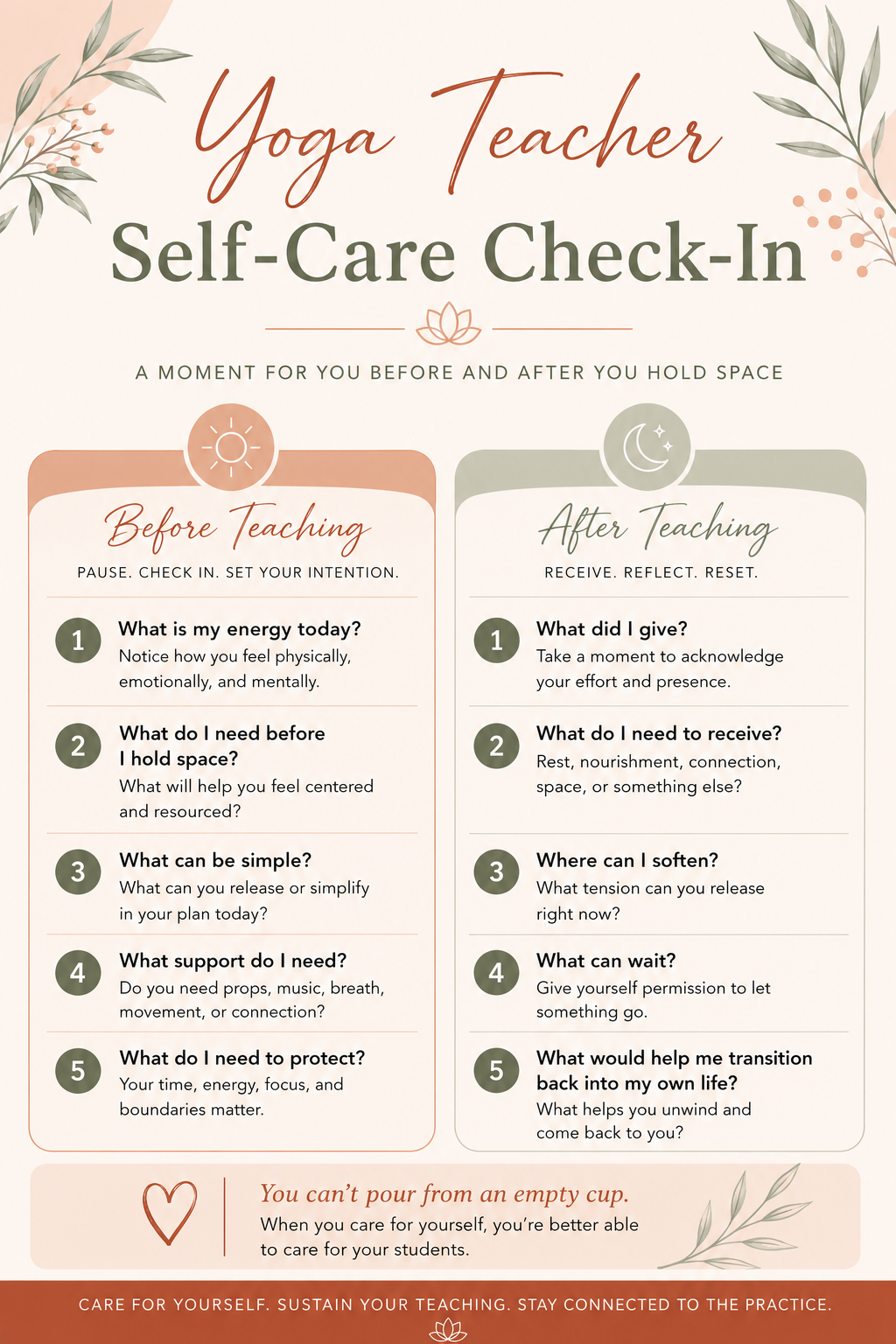
Before you teach, take a moment to check in with yourself.
Ask:
What is my energy today?
What do I need before I hold space?
What can be simple?
What support do I need?
What do I need to protect?
This kind of check-in does not take long, but it helps you enter class with more awareness.
You might take three breaths, drink water, review your sequence, simplify your plan, or remind yourself that you do not have to overgive to teach well.
After teaching, many yoga teachers rush into the next responsibility. They close the Zoom room, clean the studio, answer messages, drive home, post online, or move straight into family life.
A short transition after teaching can be powerful.
Ask:
What did I give?
What do I need to receive?
Where can I soften?
What can wait?
What would help me transition back into my own life?
Even two minutes of transition can help your body understand that the class is complete.
A weekly self-care rhythm might include:
One personal practice that is not for teaching
One period of true rest
One check-in with your schedule
One moment of continuing education or study
One connection with another teacher or supportive person
One place where you simplify instead of adding more
Self-care becomes more sustainable when it is built into your week instead of saved for the moment you feel depleted.
Boundaries are an important part of self-care for yoga teachers.
Yoga teachers often care deeply. Many want to be available, supportive, responsive, generous, and encouraging. Those are beautiful qualities. Without boundaries, they can become exhausting.
A sustainable teaching schedule should leave space for preparation, travel, rest, personal practice, and life outside of yoga.
If your schedule is packed so tightly that you have no time to eat, reset, or breathe between classes, your body will eventually feel it.
Schedule boundaries might include:
Limiting back-to-back classes
Creating time between teaching and appointments
Choosing specific times for email or messages
Taking one day off from teaching each week
Leaving space after emotionally demanding classes
Being honest about how many classes you can teach sustainably
Yoga classes can bring up emotion. Students may share personal stories. People may seek support before or after class. Teachers can become a steady presence in students’ lives.
It is meaningful to be trusted. It is also important to know the limits of your role.
Yoga teachers can be compassionate without becoming responsible for everything students are carrying.
Self-care may mean having clear referral options, staying within your scope, and remembering that holding space does not mean absorbing everyone’s pain.
Continuing education for yoga teachers is often framed as professional development, and it is. But it can also be a form of self-care when it reconnects you to curiosity, inspiration, and support.
The right continuing education course can help you feel more confident, more resourced, and less alone in your teaching.
Yoga teachers may feel burned out when they are teaching the same material over and over without nourishment. Continuing education can bring fresh language, updated knowledge, new practices, and deeper understanding.
You might study:
Restorative yoga
Yin yoga
Meditation
Yoga Nidra
Trauma-informed yoga
Accessible yoga
Prenatal yoga
Children’s yoga
Yoga philosophy
Anatomy
Cueing and sequencing
Nervous system support
Continuing education does not have to be about doing more. It can be about feeling supported in the next season of your teaching.
Not every course is right for every season. Sometimes self-care means choosing a training that energizes you. Sometimes it means choosing something slower, gentler, or more restorative.
Ask:
What would support my teaching right now?
What would help me feel more confident?
What would nourish my own practice?
What am I curious about?
What would help me teach with more care?
Learning can be part of sustainable teaching when it supports your capacity instead of overwhelming it.
A sustainable yoga teaching life is built slowly. It requires honesty about your energy, your values, your needs, and the way your teaching fits into your whole life.
It can be tempting to say yes to every opportunity, especially early in your teaching path. More classes can mean more experience, more visibility, and more income.
But more is not always more sustainable.
Teaching from your real capacity means being honest about what you can offer consistently without losing yourself.
This might mean teaching fewer classes with more presence. It might mean choosing formats that fit your life. It might mean building online offerings, continuing education, workshops, or private sessions in a way that supports your energy.
Your teaching will change over time.
The classes you teach now may not be the classes you teach five years from now. Your voice may soften, deepen, strengthen, or become more specific. Your interests may shift. Your students may change. Your own life will keep shaping how you teach.
Self-care includes allowing your teaching to evolve.
You do not have to stay attached to the version of yourself that started teaching. You can keep learning. You can refine. You can change your schedule. You can update your language. You can choose new areas of study. You can grow.
Use this simple check-in before and after teaching.
What is my energy today?
What do I need before I hold space?
What can be simple?
What support do I need?
What do I need to protect?
What did I give?
What do I need to receive?
Where can I soften?
What can wait?
What would help me transition back into my own life?
This check-in can be used before a studio class, online class, workshop, private session, or teacher training. It is a small way to practice self-care in real time.
Self-Care Month and International Self-Care Day are good reminders that self-care is not only for students. It is for teachers too.
Yoga teachers need practices that nourish them, boundaries that protect them, education that supports them, and rhythms that help them keep showing up without disappearing from themselves.
A sustainable yoga practice is still a powerful practice.
A rested teacher can still be devoted.
A simple practice can still be deep.
A softer season can still be meaningful.
A teacher who receives care can offer care with more steadiness.
Self-care for yoga teachers is not a side topic. It is central to sustainable teaching.
Your students benefit when you are resourced. Your teaching benefits when your practice still belongs to you. Your nervous system benefits when rest is part of the rhythm. Your creativity benefits when you have time to receive, study, and integrate.
Teaching yoga is a meaningful path, and it asks for care.
Not perfection.
Not constant output.
Not endless giving.
Care.
The kind that helps you return to your own practice. The kind that lets you keep learning. The kind that supports your body, your energy, your boundaries, and your life.
The teacher needs care too.
And that care is part of the practice.