
Freedom In Your Yoga Practice: What It Really Means
Learn How to Experience Liberation On Your Yoga Mat
Your Guide to Liberation On Your Yoga Mat
Freedom in your yoga practice can sound like a beautiful idea, but what does it actually mean?
For some people, freedom in yoga means feeling comfortable enough to roll out a mat at home and begin without needing the perfect setup. For others, it means using props without feeling like they are doing the “lesser” version of a pose. For a yoga teacher, freedom might mean letting your teaching voice evolve instead of trying to sound like someone else.
Freedom in your yoga practice is not about doing whatever you want without awareness. It is about building a relationship with the practice that creates more choice, more self-trust, more honesty, and more room to begin where you are.
This is one of the reasons yoga continues to be such a powerful practice for so many people. Whether you are brand new to yoga, returning after time away, deepening your yoga practice, or considering online yoga teacher training, yoga gives you a place to listen, adjust, learn, and return.
Especially around Independence Day, the word freedom comes up everywhere. But in yoga, freedom is not only an external idea. It is also something we experience internally. It is the freedom to breathe more fully. The freedom to practice without performing. The freedom to choose the variation that supports your body. The freedom to learn at your own pace. The freedom to grow into your own voice as a yoga student, yoga teacher, or lifelong practitioner.
Freedom in your yoga practice means having enough knowledge, support, and self-awareness to make choices that honor your body, breath, energy, and season of life.
It means your yoga practice does not have to look the same every day.
Some days, freedom looks like a strong vinyasa flow. Some days, it looks like legs up the wall. Some days, it looks like studying yoga philosophy, practicing pranayama, or taking five slow breaths between responsibilities.
A healthy yoga practice should give you more access to yourself, not less. It should help you notice what is happening in your body and your nervous system. It should help you build strength, steadiness, flexibility, and awareness without turning the mat into another place where you have to prove yourself.
Choice is one of the most important parts of a sustainable yoga practice.
When you practice yoga with choice, you begin to understand that there are many ways to experience a pose. You can use a block. You can bend your knees. You can rest. You can change the pace. You can skip a shape that does not feel supportive. You can choose a variation because it helps you breathe, not because it looks impressive.
This is also why choice-based cueing matters so much in yoga classes. When a yoga teacher offers options without ranking them, students get to experience yoga as a practice of agency. The class becomes less about fitting into a shape and more about learning how to listen.
Freedom in yoga also means learning to trust your own experience.
Many students come to yoga wanting to be told exactly what to do. That makes sense. Clear instruction matters. Good alignment matters. Safety matters.
But over time, yoga practice can help you build a more subtle skill: the ability to notice what is true for you.
Is your breath steady?
Does this pose feel supportive?
Are you building strength or gripping?
Are you resting because you are listening or pushing because you feel pressure?
What is your body asking for today?
Self-trust develops slowly. It comes from repeated moments of listening and responding with care.
One of the biggest barriers to starting yoga, returning to yoga, or beginning yoga teacher training is the belief that your practice needs to look a certain way before you are ready.
People often think:
I need to be more flexible first.
I need to lose weight first.
I need to have a stronger home yoga practice first.
I need to know more about yoga philosophy first.
I need to feel more confident first.
I need a perfect routine first.
But yoga does not begin after everything becomes perfect. Yoga begins in real life.
It begins with the body you have today.
The schedule you have today.
The breath you have today.
The capacity you have today.
The curiosity you have today.
If you are searching for yoga for beginners, beginner yoga classes, or how to start yoga at home, you may already be wondering whether you are “ready.”
You are allowed to begin before you feel completely ready.
Beginner yoga is not about being naturally flexible, graceful, calm, or confident. It is about learning the foundations of practice in a way that helps you build awareness and trust.
You can begin with ten minutes.
You can begin with one pose.
You can begin with breath.
You can begin with a chair, blocks, blankets, or the wall.
You can begin again after months or years away.
That is freedom in your yoga practice.
A perfect practice is usually imaginary.
A real yoga practice has interruptions. It changes with your energy, body, season, work, family, health, emotions, and responsibilities.
Some weeks you may practice every day. Other weeks, you may only get to your mat once. Some seasons are full of movement. Others are full of rest, study, or quiet reflection.
The freedom comes from letting your practice be alive enough to change with you.
Yoga props are not a sign that you are doing yoga wrong. Props are tools that can help you experience poses with more support, stability, space, and awareness.
Blocks, straps, bolsters, blankets, chairs, and walls can all make yoga more accessible. They can support alignment, reduce strain, increase comfort, and help students stay connected to the breath.
Many students still hesitate to use props because they worry it means they are not advanced enough. But experienced yoga teachers know that props can deepen the practice.
A block can bring the floor closer.
A strap can create more reach.
A bolster can support rest.
A blanket can protect the knees.
A chair can create access.
A wall can create stability.
Freedom in your yoga practice can look like using what supports you without apology.
Yoga modifications are often misunderstood. A modification is not a failure to do the “real” pose. It is one way of making the practice fit the person in front of it.
Instead of thinking of modifications as a step down, consider them an expression of intelligence.
A yoga modification can help you:
Protect an injury
Support your breath
Build strength gradually
Honor your range of motion
Practice during pregnancy or postpartum
Support chronic pain or fatigue
Stay present instead of pushing through
When modifications are offered with respect, yoga becomes more accessible, inclusive, and sustainable.
Rest is one of the most powerful and overlooked parts of yoga practice.
In a culture that often celebrates doing more, moving faster, and staying productive, rest can feel uncomfortable. Many students feel guilty resting in class. Many yoga teachers feel pressure to offer a practice that feels intense enough, creative enough, or impressive enough.
But rest is not separate from yoga. Rest is part of the rhythm of practice.
Savasana matters. Child’s Pose matters. Pauses matter. Longer exhales matter. Restorative yoga matters. Slower practices matter.
Rest gives the nervous system time to receive. It allows the body to process the work. It helps students notice the effect of the practice instead of immediately moving into the next thing.
Freedom in your yoga practice can look like resting when your body asks for rest.
A deep yoga practice does not always look intense from the outside.
Sometimes the deepest practice is staying with your breath in a simple shape. Sometimes it is choosing a restorative practice instead of a strong flow. Sometimes it is noticing the urge to push and choosing to soften.
A softer practice can still build awareness, patience, nervous system regulation, and self-trust.
One of the most beautiful things about yoga is that it always allows you to return.
You can return after a busy week.
You can return after an injury.
You can return after having a baby.
You can return after grief.
You can return after burnout.
You can return after years away from the mat.
Yoga practice is not ruined by inconsistency. It is strengthened by return.
Many people stop practicing because they miss a few days, weeks, or months and then feel like they have failed. But beginning again is part of yoga.
Every breath is a return.
Every class is a return.
Every time you come back to awareness, you are practicing.
Freedom in your yoga practice means you do not have to turn time away into a story of failure. You can simply return.
The practice you had five years ago may not be the practice you need today. Your body may have changed. Your schedule may have changed. Your emotional life may have changed. Your goals may have changed.
That does not mean something went wrong. It means your practice is in relationship with your life.
A sustainable yoga practice has room for change.
For many students, freedom in yoga also means having access to education that fits real life.
This is one reason online yoga teacher training has become so meaningful for students who want to deepen their yoga practice without stepping away from work, family, caregiving, or other responsibilities.
Online yoga teacher training can offer structure and flexibility at the same time. It allows students to study yoga philosophy, anatomy, sequencing, cueing, meditation, pranayama, and teaching methodology in a way that can fit into their actual lives.
Many people feel called to yoga teacher training long before they enroll. They wonder if they are ready. They wonder if they have enough time. They wonder if they need to want to teach. They wonder if online yoga teacher training will be supportive enough.
The truth is, yoga teacher training can be a powerful experience for future yoga teachers and for students who simply want to deepen their practice.
You do not have to have a perfect schedule.
You do not have to know every pose.
You do not have to feel completely confident.
You do not have to know exactly where the path will lead.
You can begin because you are curious. You can begin because yoga keeps calling you. You can begin because you want to understand the practice more deeply.
A deeper yoga practice is not only about harder poses. It can include studying the roots of yoga, learning about the nervous system, understanding anatomy, refining cueing, exploring meditation, practicing pranayama, and learning how to create safe, inclusive classes.
Continuing education for yoga teachers is also part of this freedom. The practice keeps unfolding. Teaching keeps evolving. There is always more to learn.
Freedom in your practice can look like remaining a student.
If you are a yoga teacher, freedom in your yoga practice also shows up in the way you teach.
Many new yoga teachers begin by trying to sound like their teachers. That is natural. We learn through modeling. We repeat phrases we have heard. We teach sequences that feel familiar. We borrow language until our own voice becomes clearer.
Over time, part of the work is letting your teaching voice evolve.
A strong yoga teacher is rooted in the practice. That means respecting yoga history, studying the philosophy, learning safe sequencing, understanding the body, and teaching with care.
But being rooted does not mean being rigid.
Your teaching voice can grow from your lived experience, your values, your personality, your community, and your ongoing study. The more you practice and teach, the more you learn what feels honest and supportive coming through you.
Freedom to teach your way does not mean ignoring the foundations. It means allowing the foundations to support your authentic voice.
Yoga teachers can feel pressure to be inspiring all the time. To have the perfect theme. To demonstrate beautifully. To always be calm, grounded, wise, flexible, and available.
But yoga teachers are human. The freedom comes from teaching with presence rather than performance.
You can teach with honesty.
You can teach with warmth.
You can keep learning.
You can refine your language.
You can let your teaching become more skillful over time.
That is part of the path.
A home yoga practice can be one of the most powerful places to explore freedom.
At home, there is no one watching. No one comparing. No one expecting your practice to look a certain way. Your home yoga practice can become a space where you learn what you actually need when performance is removed.
A yoga practice at home does not need to be long or complicated.
It can be:
Five minutes of breath
A few rounds of cat and cow
A gentle forward fold
A restorative pose
A short meditation
A slow Sun Salutation
A few stretches before bed
A seated moment with one hand on your heart
Simple practice still counts. Short practice still counts. Quiet practice still counts.
When you practice at home, you begin to ask different questions.
What do I need today?
What helps me feel steady?
What kind of movement supports my energy?
What helps me feel connected?
What am I avoiding?
What am I ready to return to?
A home yoga practice can become a place where you build trust with yourself.
Freedom in your yoga practice is not one thing. It can show up in many small, practical ways.
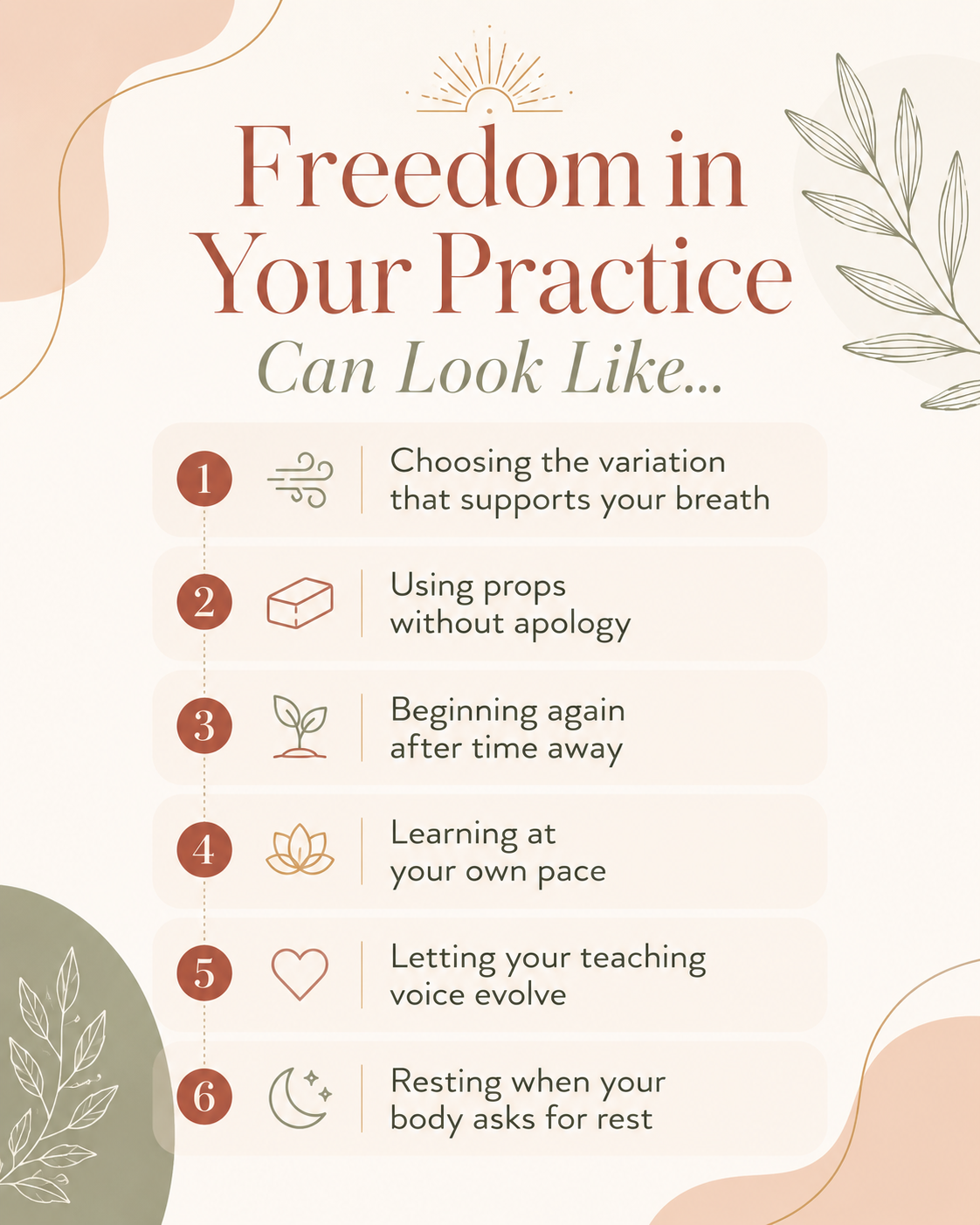
Your breath is one of the clearest guides in practice. If a shape makes your breath feel strained, rushed, or inaccessible, another variation may be more supportive.
Freedom means you can choose the version that helps you stay connected.
Props are part of the practice. Use them. Enjoy them. Let them support you.
Freedom means you do not have to apologize for choosing support.
Time away from the mat does not erase your practice.
Freedom means you can begin again without shame.
Whether you are taking a yoga class, studying online yoga teacher training, or completing continuing education courses, learning does not have to be rushed.
Freedom means your pace can be part of your path.
Your teaching voice may change as you study, practice, and grow.
Freedom means allowing your voice to become more honest, grounded, and your own.
Rest is part of yoga. It helps the practice integrate.
Freedom means listening when your body asks for softness.
Yoga helps build inner freedom by teaching awareness, choice, discipline, compassion, and self-study.
In yogic philosophy, freedom is often connected to liberation from patterns that keep us stuck. In everyday practice, this might look like noticing the pressure to perform, the habit of self-criticism, the fear of beginning, or the belief that rest must be earned.
Yoga gives us tools to notice these patterns with more clarity.
When you become aware of a pattern, you create a little space around it.
You may notice that you always push past your limits.
You may notice that you avoid rest.
You may notice that you compare your practice to others.
You may notice that you wait for perfect conditions before beginning.
Awareness is the beginning of choice.
Once you notice, you can choose.
You can choose the prop.
You can choose the breath.
You can choose rest.
You can choose study.
You can choose to begin.
You can choose to continue.
This is the kind of freedom yoga practice offers again and again.
As Independence Day approaches, it can be meaningful to reflect on freedom in your practice.
Not only as a theme for the holiday, but as a real question:
Where do I want more freedom in my yoga practice?
Maybe you want freedom from perfection.
Maybe you want freedom from waiting.
Maybe you want freedom to begin teacher training.
Maybe you want freedom to practice at home.
Maybe you want freedom to use props, rest, modify, and choose.
Maybe you want freedom to become the yoga teacher you are becoming.
Whatever your answer is, your practice can meet you there.
Freedom in your yoga practice is not about abandoning structure. It is about using the tools of yoga to create more awareness, choice, support, and self-trust.
It is the freedom to begin where you are.
The freedom to practice in the body you have today.
The freedom to use props without apology.
The freedom to rest.
The freedom to learn at your own pace.
The freedom to let your teaching voice evolve.
The freedom to return after time away.
Yoga is a practice that keeps unfolding. Every time you come back to the mat, the breath, the study, or the quiet moment of awareness, you are building a relationship with yourself.
That relationship is where freedom begins.